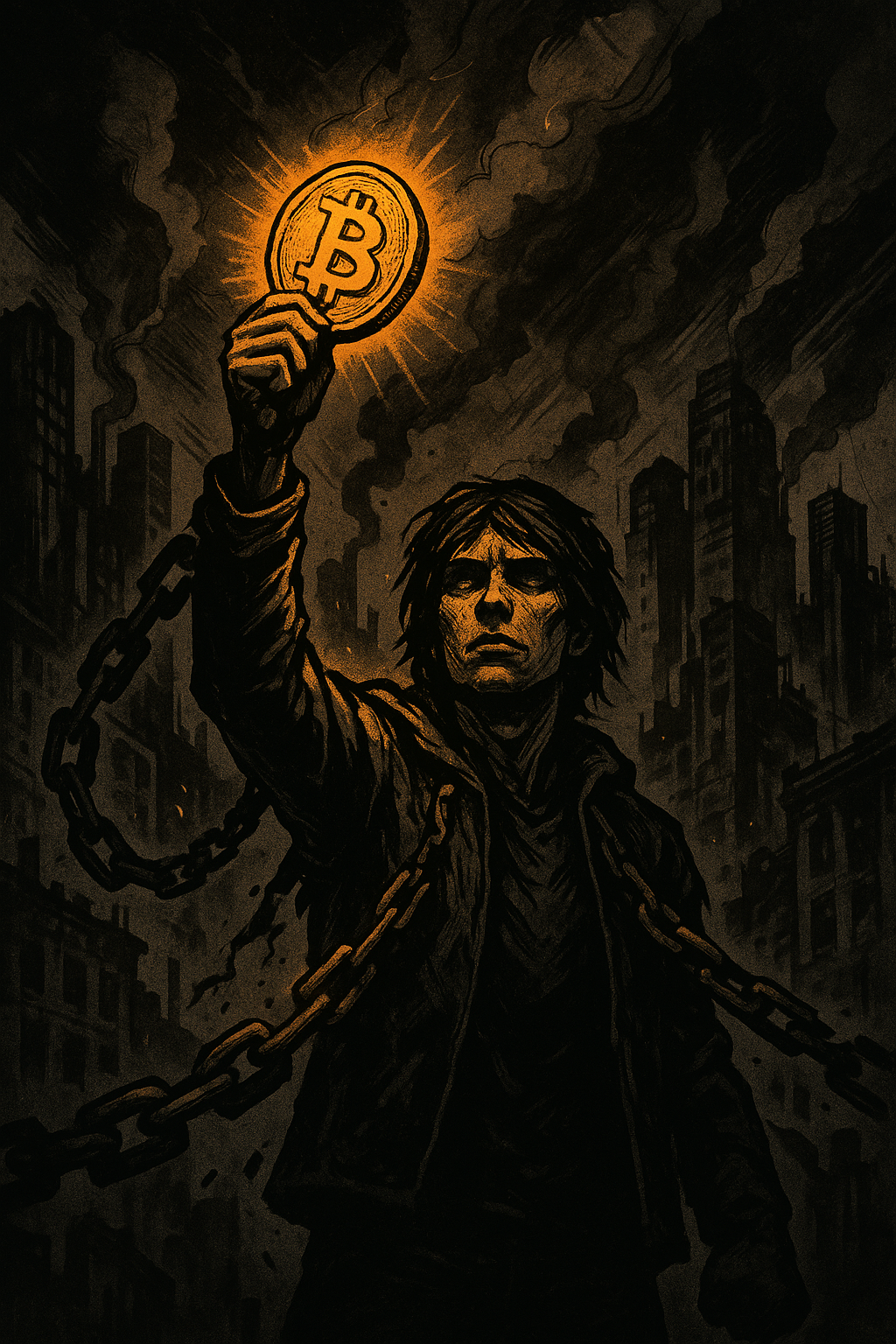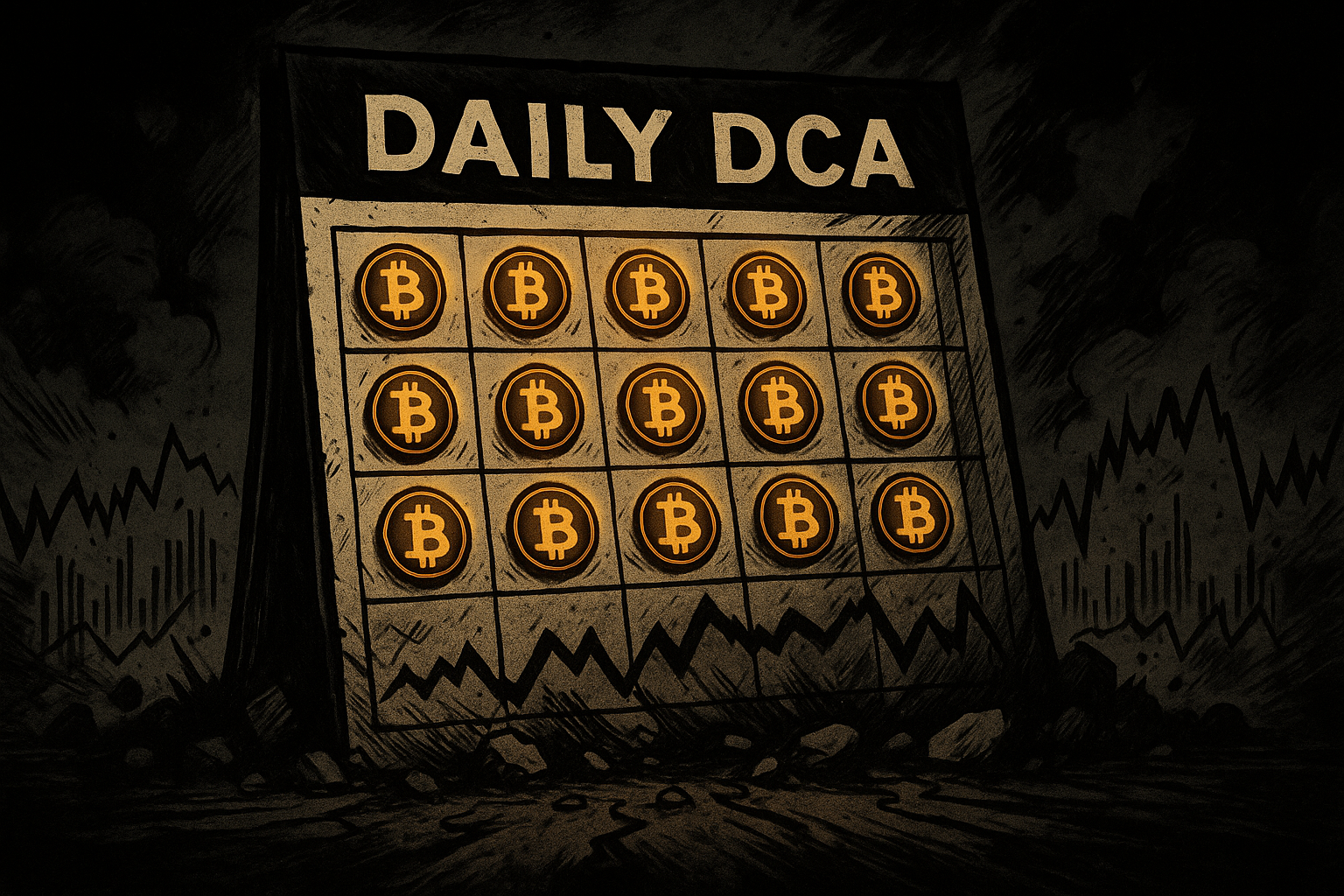
Daily DCA is the way!
Excerpt:
Timing Bitcoin is a trap. Daily DCA removes emotion, smooths volatility, and stacks sats one day at a time. Over the long run, it beats weekly and monthly strategies while keeping you consistent and disciplined.
Timing the market is a loser’s game. Bitcoin’s volatile. It rips, it crashes, it chops sideways. You’ll never hit the perfect entry. That’s why DCA exists.
Most people DCA monthly or weekly. It feels simple—line it up with payday, hit buy once in a while. But here’s the problem: those buys are chunky, and if they land before a dip, you eat it for weeks or months.
Daily DCA fixes this. You buy a small amount every single day. High days, low days—it doesn’t matter. You’re stacking through all of it. Over time, your average cost smooths out. You capture more lows, fewer timing mistakes, and less stress.
The data backs it up. Over the last decade, daily DCA has beaten weekly and monthly strategies on risk-adjusted performance. It delivers a lower average cost basis because Bitcoin trends up over time, and daily buys spread you across the whole curve. The only knock used to be fees, but with today’s exchanges offering free or near-free recurring buys, that excuse is gone.
It’s also about mindset. When you buy daily, Bitcoin becomes habit. No second-guessing. No waiting for the dip. No worrying if you’re early or late. Just stack every day, and let time do the work.
For me, it’s simple: Bitcoin is the ticket to freedom. And the best way to get there is one day at a time. That’s why I DCA daily.
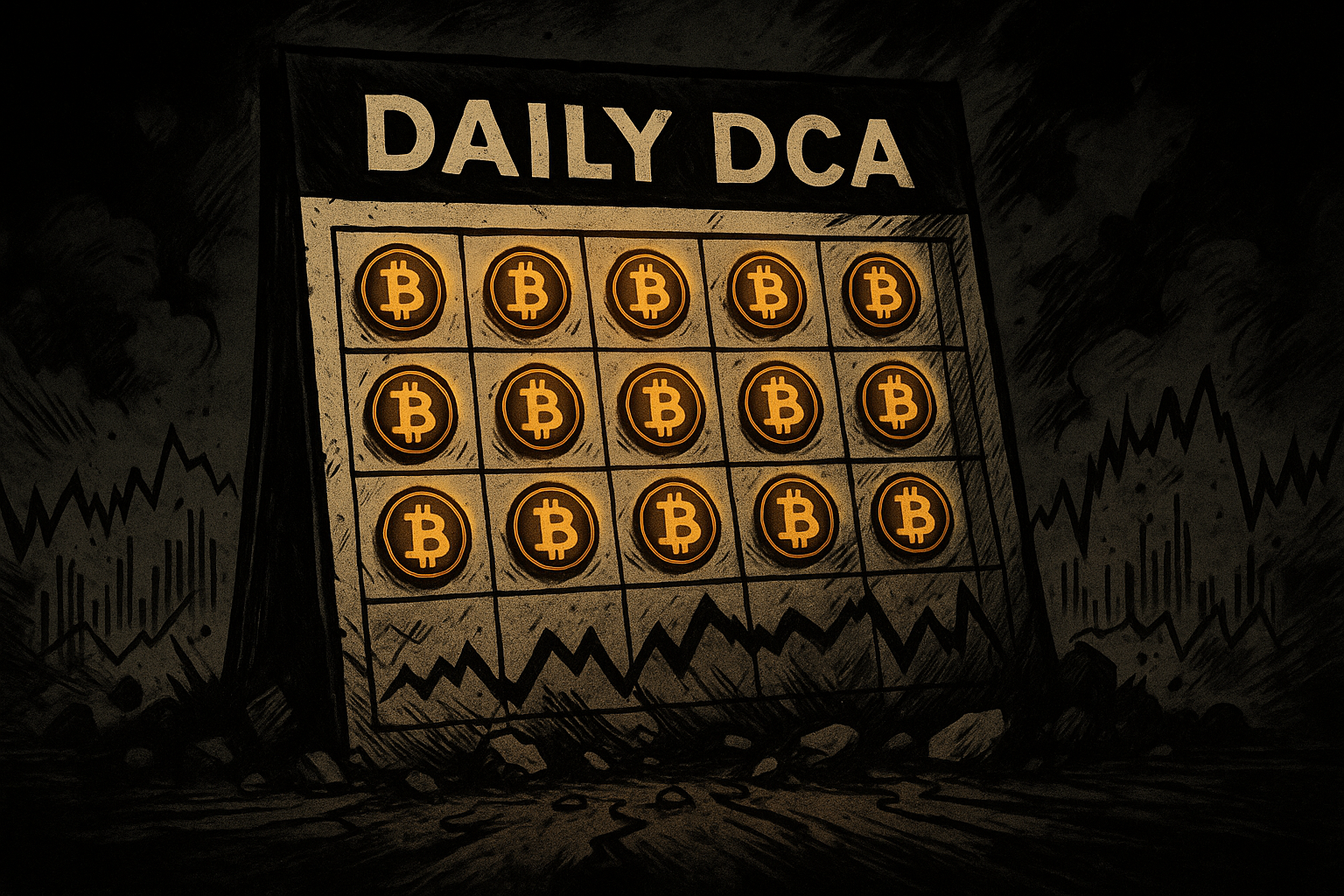

From Rome to Fiat: How Broken Money Destroys Empires
Excerpt:
Rome destroyed itself by debasing its coins. Silver denarii turned into bronze scraps, trust evaporated, and the empire fell. Today’s fiat is on the same path. The difference? This time we have Bitcoin—money that can’t be corrupted.
Rome didn’t collapse in one day. It took centuries. But the cracks showed up in its money first.
The Roman denarius started as solid silver. When it was introduced around 211 BCE, it was over 95% pure silver. People trusted it. Soldiers accepted it. Trade flowed because the money was real.
Then came the empire’s appetite. Wars, palaces, handouts to the people, and bribes to the army. Rome always wanted more than it could afford. So emperors did the same thing governments do today: they debased the money.
Nero clipped coins down to 90% silver. Caracalla introduced the antoninianus, worth “two denarii” but only containing 1.5 in silver. By the 3rd century, the coins were under 5% silver, basically bronze coated with a thin wash. By then, nobody trusted Roman money.
What happened next was predictable:
Prices exploded. A loaf of bread or sack of grain cost hundreds of times more than before.
People hoarded old coins. Gresham’s Law kicked in—bad money drove out good. The fake coins circulated, the real ones disappeared.
The military turned. Soldiers wanted land, food, or payment in kind, not worthless coins. Loyalty to the empire faded.
Taxes collapsed. Citizens dodged or paid in kind. The state couldn’t fund itself.
Trade broke apart. Barter returned. Local economies stopped trusting central money.
Rome didn’t just lose battles. It lost trust. Once the money failed, everything else crumbled.
---
The Same Cracks Are Showing Now
Look around. Fiat is today’s denarius.
Inflation. U.S. inflation hit 9.1% in June 2022—a forty-year high. Your dollars buy less every year.
Money supply. M2 exploded after 2020. The Fed printed trillions to paper over crises. More units chasing the same goods—it’s silent theft.
Debasement 2.0. Modern money isn’t clipped coins—it’s digital entries conjured out of thin air. Same effect, faster scale.
Loss of trust. People run to hard assets—real estate, gold, Bitcoin—because fiat bleeds value. Just like Romans hoarded old silver coins.
Cracks in control. Canada froze bank accounts in 2022 for political dissent. Nigeria rationed withdrawals in 2023. Lebanon locked depositors out entirely. Sound familiar? Rome did the same thing when its coins failed—it rationed, confiscated, and controlled.
Our system is showing stress fractures. Rising debt, runaway spending, weaponized money, and a currency that loses power every year. Rome’s story is playing out again—only this time it’s global.
---
The Difference: Bitcoin
Rome’s flaw was simple: emperors could change the rules. They always did. Our flaw is the same: central banks and governments can create as much money as they want. They always do.
Bitcoin is built different.
Fixed supply. 21 million. No emperor, no president, no bank can change it.
Transparent rules. Everyone can verify issuance by running a node. No secret debasement.
Borderless. It isn’t tied to an empire. It belongs to no one and everyone.
Unstoppable. Transactions can’t be censored. Wealth can’t be frozen if you hold your keys.
Rome fell when its money failed. Our fiat system will crack the same way. Bitcoin is the exit door.
---
Lessons from Rome
1. Debasement is theft. Rome stretched its coins thinner until they were worthless. Today, fiat stretches your dollars thinner with every stimulus, bailout, and war budget.
2. Once trust is gone, it doesn’t return. Romans went back to barter because they stopped believing in the coin. Today, people hedge with Bitcoin because they don’t believe in central banks.
3. The empire always spends too much. Rome couldn’t cut its appetite. Neither can Washington, Brussels, or Tokyo. Debt spirals always end the same way.
4. Money is the foundation. Armies, governments, and trade all rest on it. Break the money and everything else cracks.
---
Where We Are Now
We’re not watching history—we’re reliving it. Fiat is our denarius. Endless debt, debasement, and control are our cracks. Rome ignored the warning signs until it collapsed. Most people today are ignoring the same ones.
But the difference is we have Bitcoin. A monetary system no emperor can touch. A currency no state can debase. A store of value no inflation can quietly bleed.
Rome had no escape. We do.
---
Bottom Line
Rome fell because its money broke. Our system is breaking for the same reasons: too much spending, too much debt, too much manipulation. The difference is this time there’s an alternative.
That alternative is Bitcoin. It’s sound money for a world built on lies. It’s the ticket out of empire collapse.
Rome didn’t have a choice. We do.
And I know which side I’m stacking on.
The Alarming Ripple Effect of Today’s NPM Supply-Chain Attack
A Silent Hijack on the JavaScript Ecosystem
On September 8, 2025, Ledger CTO Charles Guillemet issued a grave warning on X: a large-scale supply-chain attack is underway, targeting NPM packages belonging to a reputable developer. These corrupted packages—already downloaded over 1 billion times—contain malicious code that silently swaps crypto wallet addresses, allowing user funds to be redirected to attackers without any warning or user awareness .
In simple terms: you could install a trusted JavaScript library and inadvertently send funds to a hacker's address without ever noticing.
---
Broader Reach: A Widespread Ecosystem Breach
Simultaneously, security outlets like BleepingComputer report that an NPM maintainer—known as Qix—was compromised through phishing. Attackers injected malware into widely used packages with 2.6 billion weekly downloads .
Together, these incidents reflect one of the most pervasive supply-chain infiltrations in history. The attack tactics? Classic: phishing to hijack maintainers, followed by malicious payload injection into trusted packages.
---
Why This Hits Crypto Developers So Hard
1. Silent theft: Wallet address swapping is stealthy—no alerts, just silent deception.
2. High trust, high stakes: Developers using widely downloaded packages may unwittingly compromise critical systems.
3. Chain reaction: A single infected package can cascade through countless downstream projects.
4. Crypto at risk: Cryptocurrency projects are direct targets, with stolen funds lining attackers' pockets.
---
Lessons from Recent NPM Supply-Chain Attacks
These recent intrusions illustrate a chilling trend:
Nx build system breach (late August 2025): Malicious NPM uploads harvested GitHub/npm tokens, SSH keys, wallet credentials, and more—exposing over 20,000 files and 1,000+ GitHub tokens before removal .
“eslint-config-prettier” and “is” packages compromised (July 2025): Through a spoofed npm support email, maintainers were phished, and malware was pushed—an infostealer called "Scavenger" and a WebSocket backdoor enabling remote code execution were deployed .
These events underscore how even tools trusted for style formatting or utilities can become destructive vectors.
---
Why Crypto Developers Must Act—Now
Threat Vector Overview
Malicious wallet swaps Replace intended crypto destination with attacker address silently.
Token & key exfiltration Harvest SSH keys, tokens, and wallet files from developer systems.
Ecosystem trust attack Infect a core dependency, propagate the damage across projects.
Mitigation Steps:
Audit dependencies thoroughly before use.
Lock and pin dependency versions, avoid auto-updates in production builds.
Enable reproducible builds to detect unauthorized changes.
Vet any post-install scripts in packages.
Isolate critical infrastructure—consider containerization or sandboxing.
Stay informed—follow security advisories for NPM and crypto tools.
---
In Closing
The current NPM supply-chain attack is more than an abstract risk—it’s a direct threat to cryptocurrency developers and the broader JS community. As of September 8, 2025, developers must treat every dependency as potentially weaponized.
By strengthening audit protocols, version control, and awareness, we can better defend against these stealthy and system-wide compromises.
Bitcoin is the ticket to freedom
Excerpt:
Fiat is control. Bitcoin is freedom. With 21 million hard-capped supply and no central authority, it’s money that can’t be printed, frozen, or stolen by inflation. Every sat stacked is a step out of slavery and into independence.
Fiat isn’t money—it’s control. Governments print it when they want, banks restrict it when they want, and inflation eats away at the value of your labor. In June 2022, U.S. inflation hit 9.1%, the highest in forty years. M2 money supply exploded after 2020. That wasn’t an accident—it was policy. More units chasing the same goods. Your savings quietly stolen. Meanwhile, 1.4 billion people around the world don’t even have access to a bank. For them, the system doesn’t just fail—it doesn’t exist.
And when things get tense, the system shows its teeth. In Canada, the government froze 206 bank accounts during the 2022 trucker protests. In Nigeria, withdrawal limits and a chaotic banknote swap created cash shortages. In Lebanon, deposits were trapped by informal capital controls, leaving people unable to access their own money. That’s not financial freedom—that’s financial slavery.
Bitcoin fixes this. Its supply is capped at 21 million. No government can change it. Transactions are permissionless—no bank can block them. And Bitcoin is portable. With a seed phrase, you can carry your wealth across borders in your head. It’s money you actually own.
This isn’t just theory. In 2021, El Salvador made bitcoin legal tender. The rollout wasn’t perfect, but it proved governments can adopt open money. Remittances are another example: sending $500 costs an average of 4.26% on traditional rails, while Bitcoin and Lightning slash fees and speed up settlement. And when banks freeze or fail, bitcoin is there. Canadians, Nigerians, and Lebanese all learned the same hard truth: if your wealth sits in their system, it’s not really yours.
Today, Bitcoin is used both as a store of value and as money. Scarcity makes it credible for long-term savings. And with the Lightning Network, it’s becoming viable for everyday payments. In August 2023, River reported 6.6 million routed payments on Lightning, averaging about $12 each, with a 99.7% success rate. That’s proof the technology works.
Of course, Bitcoin isn’t magic. Volatility is brutal—50% to 80% drawdowns happen. Custodial risk is real—FTX collapsed with over $1 billion in customer funds missing. And energy consumption is often criticized, though Cambridge provides data showing the trade-offs in security. On top of that, self-custody means responsibility. There are no bailouts if you lose your keys.
So how do you approach it? Start by defining your goal—are you hedging inflation, protecting against censorship, or making fast payments? Buy in boring with dollar-cost averaging and never touch leverage. Move your stack to self-custody with a hardware wallet, and secure your seed phrase with offline backups. Keep only your spending balance on exchanges or hot wallets. If you want to transact, use Lightning. And above all, treat your security setup like the deed to your house.
Here’s the bottom line: fiat is built to control you. Bitcoin is built to free you. But it only works if you take custody. That’s the trade—responsibility in exchange for freedom. I’ll take it.
---
Sources: IMF, World Bank, Federal Reserve, U.S. Bureau of Labor Statistics, Cambridge Centre for Alternative Finance, River, Reuters, BBC.